Charge: To provide an interface for the Association with the legal, judicial, and criminal justice communities.
As such, it will:
- help to disseminate information about legal and justice statistics activities throughout the statistics community;
- promote the development of quality statistical activities in civil and criminal justice settings;
- enhance the communication and presentation of statistical evidence in legal settings;
- consider and report on relevant issues to guarantee the integrity of statistical programs maintained by the U.S. Department of Justice and other appropriate agencies and organizations.
Recent webinar: June 11th, 1-1:30pm ET
Cohosted with the ASA Committee on Scientific Freedom and Human Rights
Recording posted soon!
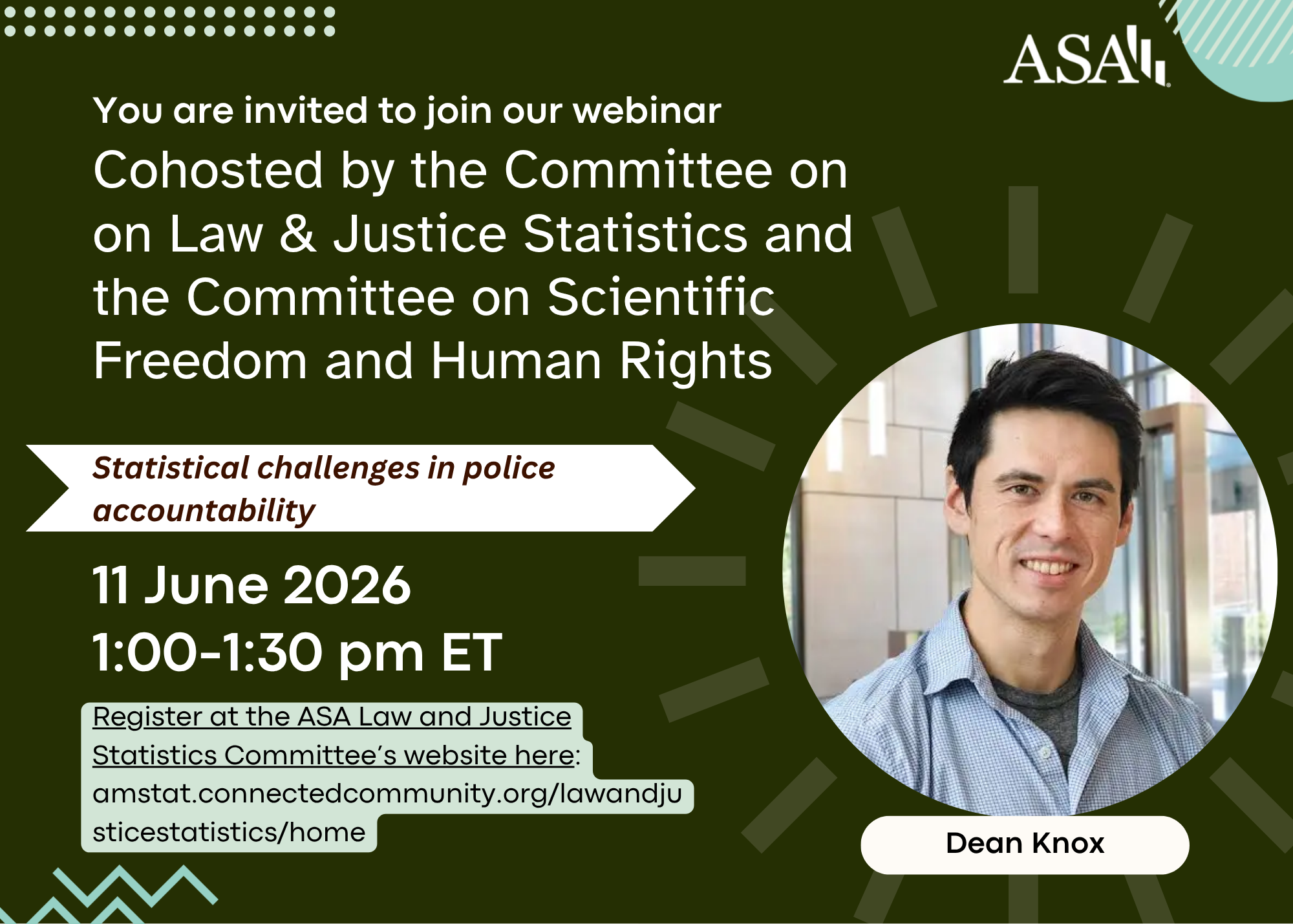
Abstract: Statistical analyses are now central to public discourse and policy-making about policing in the United States and beyond, but widespread support for "evidence-based policing" belies the difficulty of rigorous policing research. In practice, analyses are often driven by convenience, applying standard techniques to readily available administrative datasets, rather than by formalizing policy questions into precisely defined estimands and then developing statistical estimators that recover them. Key challenges inherent in policing data—including unavoidable selection, mismeasurement, and missingness issues—are frequently ignored, leaving the policy implications of many analyses unclear. We review key policy questions, with a particular focus on racial bias and excessive force, then discuss how these data challenges have led to spurious findings in the study of police accountability. Finally, we propose statistically principled approaches drawing on graphical causal models and partial identification.